Posts

Showing posts with the label Collaboration

What are the Grade 10 students working on?


Every Wednesday, during PIE, the Grade 10 students gather in MP1 in order to touch base with teachers, and with each other, about their MYP Personal Projects. This is a time to collaborate, to get advice, to document progress and just to get on with their projects.

In this Buffalo Voices Podcast, on AISM Radio, seven of them chat with Sam Sherratt about what they're doing for their MYP Personal Projects and how it's going so far. Enjoy listening to Elisa, Hayden, Helen, Sydney, Tyra, Misa and Daniel talk about each of their very diverse projects!

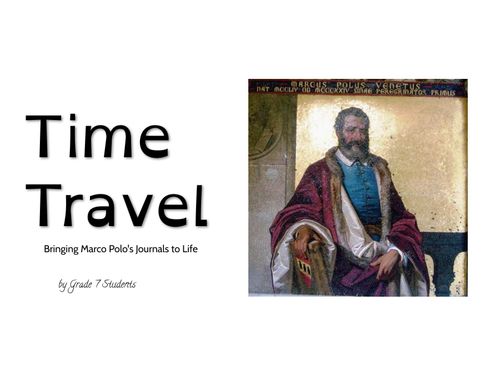
A Time Travel Project in Grade 7


In Individuals & Societies, Grade 7 students are learning about exploration and the increasingly inter-connected world that resulted from these explorations. They did a case study of Marco Polo and used his journals to as a primary source of information about his experiences. In this creative project, they traveled back in time and put themselves in Marcom Polo's shoes as he encountered some of the wild animals, advanced systems and the use of resources that were present in China in the 13th Century. 
They used the costume room in the Auditorium in order to look as convincing as possible, the used the green screen and a digital camera to take the photos they needed for each situation, they found appropriate background images, they cropped the original photos using editing software and then layered the cropped images on top of the background image. Finally, they used Instapainting to convert the image into something that looks like a painting or drawing because, of course, cameras didn't exist in the 13th Century! 


Here is their work in the form of a digital book! Please click the link to take a look.

Grade 8's Short Films


During their English lessons, students in Grade 8 did a whole unit on Film. Either in groups or on their own, either in campus or in other parts of the world, the students developed concepts, wrote scripts, selected music and sound-effects, chose locations, filmed and edited eight amazing - and very different - short films.

You can watch all of the films in the Grade 8 Virtual Film Festival below:

Grade 6 Seven Modern Wonders of the World


To conclude their inquiry into ancient civilizations, geography key themes, map making skills and settlements, Grade 6 students carried out a research and decision-making activity, to produce a list of their own Seven Modern Wonders of the World, following their inquiry into the original ancient modern wonders of the world, created by the ancient Greeks. Each presentation of the Seven Modern Wonders of the World had to have their own set of criteria, by which the students who created them, considered them to be a 'Wonder'. In turn, the class collaboratively devised a set of criteria by which to judge each others' presentations of their Seven Modern Wonders of the World. Special mention goes to Belva and Cala, and Laia, whose two presentations were deemed to be the joint winning presentations by their class of peers. 

The question is, which presentation of the Seven Wonders of the World do you consider to be the most wonderful?

Here are some examples of their presentations.

Akira, Jae, Mohamed and Oskar:

Polly, Theo and Michelle:

Laia:

Heather:

Belva and Cala:

Lucas and Jacques:


Grade 3 Students Taking Action for Change


Dynamic duo, Chica and Zayli, in Grade 3, have been working on their passion project every week on Flex Fridays. Their plan is to raise money for Mozambican schools that need more educational materials or to done to organizations that provide clean drinking water to children - they're still deciding! They are raising the money by selling products made of Capulana material.

Chica and Zayli intend to continue with this project next year, when they are in Grade 4, and so they want the community to know about the project and keep an eye out for it next school year!

Grade 8 Students' Science Research Published Online!


Grade 8 Students at AISM explored how scientists use evidence to study the process of evolution. They took part in an academic research process and wrote about what they discovered. This magazine is the result of their efforts. It is 100% researched, written, edited, laid out, and published by students. Take a look and see what they were curious about when exploring evolution. The results will blow you away.

Please click on the image or on this link to see the magazine.

Grade 6 "A Little Bit of Stomp" Performances


Grade 6 students have been combining story-telling and the creation of rhythms using everyday objects. It started out as a fairly simple musical project, but the students' imaginations,  creativity and desire to explore and experiment with costumes and props turned it into something bigger and better than the original plan!

Here's the Grade 6 Virtual Theatre showing, for one week only... "A Little Bit of Stomp"!

The Buffalo Trail Podcast - a CAS project


Grade 11 students Beamlak, Rylan and Isabelle, have been developing their Creativity, Activity and Service project in the form of a podcast. Through the Buffalo Trail Podcast, they are aiming to inspire curiosity, listen to and share different perspectives and increase the communication between different grade levels in the school.

You can listen to their podcast on Spotify:
 

You can listen to their podcast on iTunes:


... and we are also hosting the podcasts on the AISM Radio Soundcloud account!

Buffalo Voices Podcast - The Grade 11 Core Retreat


Grade 11 students just had a Core Retreat in which they were able to dedicate some time to the Core of the IB Diploma. This is made up of Theory of Knowledge (TOK), the Extended Essay and Creativity, Activity and Service. 

In this podcast, Sam Sherratt finds out more about the retreat, what happened and what impact it had by chatting to Gabriel Di Mauro (IB Diploma Coordinator), Rui da Silva (Extended Essay Coordinator), Colleen Fletcher (CAS Coordinator) and two Grade 11 students, Rylan and Jana.

Grade 10 Inquiry into the Sustainable Development Goals


Grade 10 are currently presenting the work they've done during their inquiry into the UN Sustainable Development Goals (SDGs), with the outcome of the inquiry being a sustainable, actionable solution to a local issue (which is also a world-wide issue related to SDGs).

The context for the unit of inquiry was to develop an understanding of the impact of the linear economy globally, and to consider how the UN SDGs can overcome global issues, within a local context, with students carrying out personalised inquiries and creating sustainable solutions and action. This inquiry ties in with the transition of Grade 10 to the IB Diploma and High School programme in two ways: to mirror an inquiry into the UN SDGs as per the Environmental Systems and Societies Internal Assessment and to engage students in Creativity, Activity and Service (CAS) experiences, building a foundation for continued action in Grade 11 and Grade 12.

The unit of inquiry began with guest speakers from within the AISM community. Niall Tierney spoke about the history of the UN SDGs and his own involvement in developing them and implementing them. Florentine Bourdeaux spoke about the application of a circular economic model of industrial production in Maputo at the Beluluane Industrial Park, working on transforming the park into an eco-industrial park. Colleen Fletcher and Jasmine Howell spoke about the importance of sustainable action (economic, social, environmental), based on indigenous knowledge bearers, the Compass Model and spheres of influence.

Here are a few examples of the presentations the students have put together.

Ashutosh and Arvind's work focuses on sustainable, affordable water filtration systems for the local community in order to promote Clean Water and Sanitation (SDG6) and to counter the use of single-use plastic and climate change:


Sanjana, Saira, Maria Clara and Georgia's work focuses on making organic hand sanitizer to support the Health and Well-Being (SDG 3) and Clean Water and Sanitation (SDG 6) of a local school in order, ultimately, to influence Quality Education (SDG 4): 


Margret's work focused on Clean Water and Sanitation (SDG 6) and ensuring sustainable management of water and sanitation for all, with a focus on Mozambique:


Madeleine's work focused on seeing if solar paint is a plausible innovation to develop Affordable and Clean Energy (SDG 7):


Research, our Librarian and a slice of the PIE!


For three days last week, our whole-school Librarian, Leah Ittner, Zoomed into the Grade 8 classes during PIE (Personalization, Intervention, Extension) time to introduce the learners to the library resources and databases that are available to them for their research. Reminding students that anyone can make a website, it is important to use the carefully curated databases to get reliable facts and information about topics. She also showed tools that can help learners cite their sources easily, translate texts into any language, and listen to articles in order to support with comprehension. 

"The students responded really well to Leah’s openness and general disposition. Many are thinking about reaching out to her for support because they thought she was so nice! It was a great kick-off to our research process" said Peter Hennigar, Grade 8 Science Teacher and Advisor.

Here are the Slides that Leah used in order to share this information with Grade 8 students.


How the Zebra got its stripes!


Grade 6 and Grade 10 collaborated to put together this brilliant performance of a traditional African tale and showed that performances can still be done in the middle of a pandemic - the production was staged completely outside, masked and socially distanced!

Even more impressive is the fact that the students were able to entertain physical audiences on campus, online audiences through a Facebook live stream and countless other audiences through this video of the whole thing. All sorts of collaboration was necessary in order to make it all happen, showing how powerful drama is as a way of bringing community together.

AISM Earth Day Buffalo Talks


On the 31st of March, we continued our series of Buffalo Talks. These talks are aimed at connecting people in our community with people in Maputo and beyond who are taking action and doing work that reflects our school's mission.

The 31st of March was Earth Day, so the focus was on environmental issues. An inspiring line-up was created and the programme was put together and hosted by our amazing Grade 11 Environmental Committee - Lara and Jana.

Larissa Sousa spoke about the Girls' Education Programme in Gorongoza National Park. Her talk starts here.

Olivier Hamerlynck spoke about the incredible Macaneta wetlands, just a short drive from AISM. His talk starts here.

Dorkhanay Paykhar spoke about the Circular Economy and the work she is doing with the African Circular Economy Network. Her talk starts here.


Clay Play and Glaze Days in Grades 9 & 10


As part of a unit exploring the major isms and movements post 1850 (give or take), we used Art Nouveau with its emphasis on hand crafting and nature-inspired decoration as our starting point for learning ceramic basics. 
Using templates, we hand built cylinders, using the correct joining method. Then, according to their plans, students added relief designs or carved into the clay. Some students made cut-outs and adapted the top edge. 

The pots were firstly bisque-fired to 900○. Then the students glazed their vessels, again following a glaze plan. Lastly the final magic occurs, during the glaze firing to 1200○. It is so exciting to have the kiln, so that students can truly appreciate the full process behind the enduring artform of ceramics.

MAP Growth Testing Update: Looking at Data


We have started two weeks of faculty inquiry into the MAP data - starting with a look at the data across the whole school and then moving on to a closer look at data in grade levels, subject areas and for individual students

The video above - Part 2 in our series of videos about MAP Growth testing at AISM this year - explains some the things we have already seen in the data, gives families some guidance about emotional reactions to test scores, explains where MAP fits in the whole story of assessment at AISM and explains the timeline for sharing reports with families.

If you have any questions about the content of this video, please feel free to contact Sam, our Director of Learning.

Sharing the Planet in Grade 2


In our Sharing the Planet unit of inquiry, Grade 2 learners have been inquiring into living things in different environments and how humans share those environments with living things.

We met with one of our parents, James Hogg, who is an Environmental Scientist and avid bird-watcher. He shared information about different habitats in Maputo and the birds we might encounter in each habitat. We also  learned about the importance of planting indigenous plants to support local wildlife.


We were also inspired by Jadav Payang, the man who planted a forest, and 2004 Nobel Peace Prize winner Wanagari Maathai, who told the story of the Hummingbird taking action.  We decided to plant indigenous trees and reached out to Ms. Colleen who taught us about the Spekboom plant, a super plant amongst plants!  She kindly shared some cuttings with us that we were able to plant and will be caring for on campus.  


Furthermore, we have been reading poems and stories about different habitats, and the 2H  Hummingbirds decided to write their own to show appreciation for the Earth.


Kindergarten's Urban Safaris!


During their Sharing the Planet unit of inquiry, Kindergarten students are learning about the living things that share our environment:

Central Idea: When we look closely and wonder, we learn appreciation and respect for living things in our environment.

Lines of Inquiry:

  • The features and behaviours of living things
  • How features and behaviour connects to where they live (habitats)
  • Respect and appreciation for living things

While the AISM campus was closed, they were challenged to go on an "urban safari" around their homes to see what living things they could find. Then, they were asked to document what they saw and record their ideas and thoughts about the features and behaviours of living things in their environments.

Here are two of those urban safaris!


Many thanks to Arielle, Pedro and their families for sharing these wonderful explorations and documentation with us.

Photo by: Rikki Chan on Unsplash


Our Virtual Library - Getting Real Books in the Hands of Students!


We are pretty proud of our AISM Virtual Library!

Getting real books into the hands of our students was a real priority at the start of this year, and the Library Team came up with a plan that would allow families to:

  • go to the Virtual Library through our Virtual AISM site
  • check the Library Catalogue
  • complete a form in order to check books out
  • request that they be left at the front gate of the school for collection
  • come and collect the books
  • read them!
  • bring them back to the front gate
  • have them checked back in to the system
  • do it all again!

When books are returned, they are quarantined before becoming available for check-out again.

So far, there's been over 120 individual requests and roughly 350 books checked-out, read at home and then returned. The families whose names appear the most in the check-out forms are the Quelhas, Wei, Abraham, Ayala and Campos families - well done!

Please continue to make the most of this service in the next few months - it gives our Library Team great satisfaction to see books going out of, and coming back into, our Library.


Collaborative Assessment Design in the MYP

Designing assessment methods that are varied and fit-for-purpose for the curriculum, learning outcomes and objectives is a challenging and intellectually stimulating part of being an IB teacher!

In the Middle Years Programme (MYP), teachers plan and design assessments that are formed around conceptual learning and that are based on the criteria in each subject area. Collaborating with each other in order to do this work inevitably improves our capacity to design effective assessments, and typically that collaboration would happen in meetings with groups of teachers sitting around tables. That's just not possible at the moment... and teachers all over the world are really missing those opportunities. However, platforms like Google Docs help us to continue to collaborate in ways that transcend time and location!

In this example (click here to open the document), Francois Mccurdy created a Mathematics assessment task and then shared it with some colleagues in order to get feedback from them. By commenting on the document, and highlighting particular parts of it, Francois' colleagues asked questions and pointed out things that could be improved or re-thought. 

In the dialogue that evolved in the comments, you can see clearly how Francois was able to take feedback and use it to improve the task.